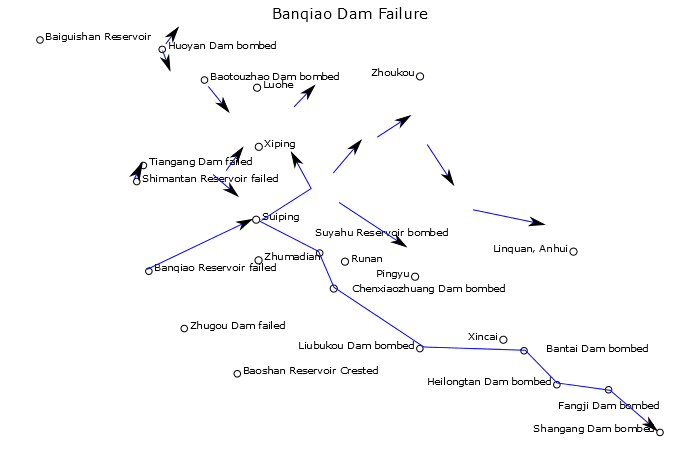
In the first week of August 1975, Typhoon Nina stalled over central China and dropped more than forty inches of rain in a single day on Henan Province. The Banqiao Dam, designed to withstand a once-in-a-thousand-year flood, was hit with a once-in-two-thousand-year flood. The dam failed at half past midnight on August 8. The Shimantan Dam upstream had failed an hour earlier. Sixty-two smaller dams failed in sequence in the same drainage. A wall of water nine miles wide rolled across the plain.
The official Chinese death toll is 26,000. The disease and famine that followed brought the total, according to the more credible accounts, to somewhere between 170,000 and 240,000 people. It remains the deadliest dam failure in human history, and it remains the dam failure the rest of the profession knows the least about.
The engineering story is straightforward. The spillways were undersized for the actual storm. The flood routing assumptions, made in the 1950s, were based on a sparse rainfall record and political optimism. The dams were earthen. When they overtopped, they did what earthen dams do.
That is the engineering story. It is the wrong story.
The Story Is The Memo.
A Chinese hydrologist named Chen Xing studied the original Banqiao design in the early 1950s. He concluded that the dam needed twelve sluice gates to handle realistic flood events. The design was approved, over his objections, with five. He was labeled a "right-wing opportunist" for his trouble. His career was effectively over.
That sentence, he was labeled a right-wing opportunist for his trouble, is the failure.
The reason Banqiao matters to dam safety in the United States in 2026 is not that the political system that produced it was unusual. The reason it matters is that the mechanism it used to override its engineers is not unusual at all. Every dam-owning organization in the world has a version of it. Ours are quieter. They do not call you a right-wing opportunist. They call you "not a team player," or they say "we need to find someone with more flexibility," or they simply stop including you in the meetings that matter.
The mechanism is the same, and it deserves a name. Call it the quiet filter. The engineer who tells the organization what it does not want to hear becomes, over time, the engineer the organization stops listening to. And once the technical voice that disagrees is institutionally separated from the technical voice that decides, the organization's safety case is no longer being made by engineers. It is being made by the people who survived the filtering process, which means it is being made by people who already agree with the answer.
The Quiet Version.
This is the part I want every dam owner in the country to sit with for a moment, because it is the part that is hard to see from inside the organization.
You will not, in 2026 America, have a hydrologist labeled a counterrevolutionary and sent to a labor camp. You will have a thirty-four-year-old engineer at your consulting firm who, over the course of two projects, learns that her flood routing concerns are received with visible annoyance by the partner who controls her staffing. She does not stop having the concerns. She stops voicing them. Two years later, she is reading her own draft reports and removing the cautionary language before she sends them. Five years later, she is the partner, and the next thirty-four-year-old is learning the same thing.
That is the quiet filter running at low temperature. It does not produce a catastrophe in any single project. It produces, across a generation, a profession whose technical voice has been trained to match the answer the client wants. The catastrophe comes when reality, the typhoon, the atmospheric river, the once-in-two-thousand-year storm that was always coming, arrives in an industry that has, slowly and without anyone noticing, stopped being able to hear the engineers who would have warned about it.
Here is the part the profession does not like to name. Most owners and most senior consultants have run the filter at least once. Not by retaliating. Not by excluding anyone. By quietly staffing the engineer who brought a difficult finding onto fewer projects the next quarter, and telling themselves it was a question of skills-to-project fit. It was not. It was sanding down the edge of the person who had said the uncomfortable thing. The fact that it never gets said out loud, even to the person doing it, is precisely how the quiet filter operates.
Three Questions.
For owners: think about the engineer on your portfolio who most frequently disagrees with your operations team. Are they on more of your projects this year than last, or fewer? If fewer, ask yourself why. The honest answer tells you whether you are running a safety program or a comfort program.
For engineers: when did you last write a finding that you knew the client would push back on? If you can name the project, you are doing your job. If you cannot, you should be uncomfortable.
For regulators: the consultants who appear most often before you, are they the firms with the strongest technical reputations, or the firms with the most agreeable demeanor? In a well-functioning system those are the same firms. In a Banqiao system they are different firms, and the difference is invisible until the storm.
The Good News.
Here is the good news, because this is DamNews. Chen Xing was not silenced for being wrong. He was silenced for being inconvenient. The distinction matters, because being right turns out to be a very durable property, the typhoon does not care what the organization decided to label the engineer who predicted it. Reality eventually rules in favor of the people who were paying attention.
The opportunity for any dam owner reading this is to build an organization where being right and being inconvenient are not the same thing. That is not a technical problem. It is a cultural one, and culture is built one decision at a time. The next time an engineer in your organization brings you news you do not want, watch your own reaction. Watch the reaction of the people in the room with you. The engineer is watching too, and the next twenty years of your safety culture depend on what they see.
Twelve sluice gates was the right answer in 1950. Saying so cost a man his career. It would have cost the Chinese Ministry of Water Resources twelve sluice gates. The arithmetic was not difficult. The arithmetic is never difficult. The hard part is the room.