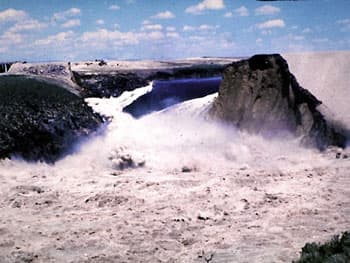
On June 5, 1976, at 11:57 AM, Teton Dam in Idaho gave way. The reservoir emptied in about five hours. Eleven people died, 13,000 head of livestock were lost, and the downstream towns of Wilford, Sugar City, and Rexburg were largely destroyed. The damages, in today's dollars, run north of two billion.
Every engineer reading this knows the textbook answer. Hydraulic fracture. Erodible loess fill. Open joints in the rhyolite abutments. The grout curtain didn't seal what it was supposed to seal. The chimney drain didn't catch what was already moving. You can read the failure modes in any geotechnical course in the country.
That's the engineering story. It is also, almost entirely, beside the point. The engineering is rarely what fails first.
The Real Failure Was Human.
Teton was not a project where the engineers didn't know. Geologists inside the Bureau of Reclamation flagged the abutment geology. The U.S. Geological Survey raised concerns in writing. Independent reviewers questioned the design philosophy of using highly erodible silt as the impervious core. The warnings existed. They were filed, distributed, and then absorbed by an organization that had decided, at a level above the engineers, what the answer was going to be.
The Bureau in 1972 was not the Bureau of 1928. It had built Hoover, Glen Canyon, Grand Coulee. It had a culture of being right. When a 250-foot-tall earthfill dam was being placed on an abutment riddled with open joints, the institutional answer to "are we sure about this?" was, in essence, "we're the Bureau."
That sentence, we're the Bureau, is the failure. Not the loess. Not the grout.
Why Smart People Built It Anyway.
This is the part the profession does not like to dwell on, because it implicates not soil mechanics but human nature. Smart, well-trained, experienced people sit in rooms where the right thing to say is uncomfortable, and find reasons not to say it.
Confirmation bias: once a design path is chosen and committed to in writing, in budget, in political testimony, the cost of reversing it is enormous, and reviewers unconsciously calibrate their findings to be survivable within the existing plan.
Authority gradient: a junior geologist who writes "I'm concerned about the abutments" and a senior chief engineer who writes "we have adequate measures in place" do not have equal voices in a meeting, even when the geologist is correct.
Sunk cost: the more concrete has been poured and the more political capital has been spent defending the project to Congress, the less the organization is psychologically able to hear bad news.
Diffusion of responsibility: when forty people review a design, no one of them owns the decision to stop. Everyone assumes someone above them, or beside them, would have caught it if it were truly wrong.
And the one that matters most, because it never goes away: the dam is going to hold because the dam has to hold. The reservoir is being filled. The ceremony is scheduled. The water users are waiting. The career consequences of being the engineer who calls for a delay are immediate and personal; the career consequences of being the engineer who didn't are distant, plural, and shared.
That last calculation, immediate and personal versus distant and shared, is the most dangerous arithmetic in our profession. It is the arithmetic that built Teton.
What This Means For Anyone Building, Operating, or Inspecting a Dam Today.
Every generation of engineers believes the previous generation's failures were caused by something specific to them, the materials, the codes, the computer tools, the regulatory environment. We tell ourselves the Bureau of 1976 had a culture problem that we have moved past. We have not. The names of the agencies have changed. The pressures have not.
If you are an owner, ask yourself honestly: when your engineer brings you uncomfortable news, what happens to that engineer's standing in your organization? If the answer is anything other than "their standing improves," your organization has a Teton problem, and the geology is irrelevant.
If you are an engineer, ask yourself: in the last twelve months, did you soften a finding, defer a recommendation, or quietly accept a closure of an issue you weren't actually satisfied with? Not because you were wrong, because raising it again was going to cost you something. That is the calculation that fails dams.
If you are a regulator, ask yourself whether your review process has, somewhere along the way, become a system that helps owners and engineers feel reviewed rather than a system that catches what they missed.
The Good News.
Here is the good news, because this is DamNews: human nature is the failure mode that responds best to being named. It is, in fact, the reason we started DamSafety.IO. You cannot redesign a dam after it is built. You can, in any week, in any meeting, change how your organization receives bad news. You can make it cheaper, professionally, for the person in the room with the concern to say it. You can read a draft inspection report and ask, "what did you almost say but decide not to?" You can promote the engineer who called for the delay that turned out to be unnecessary, instead of the one who let it slide and got lucky.
Dams are built by people. They fail by people. They are kept safe by people who have been given permission, in advance, to be the one who stops the pour.
That permission is the most important piece of safety infrastructure on any dam in the country. It does not appear on any drawing. It costs nothing to install. It is, almost without exception, the thing that was missing in every dam failure since records have been kept.
It was the thing missing on June 5, 1976.
It is the thing we can fix this week.