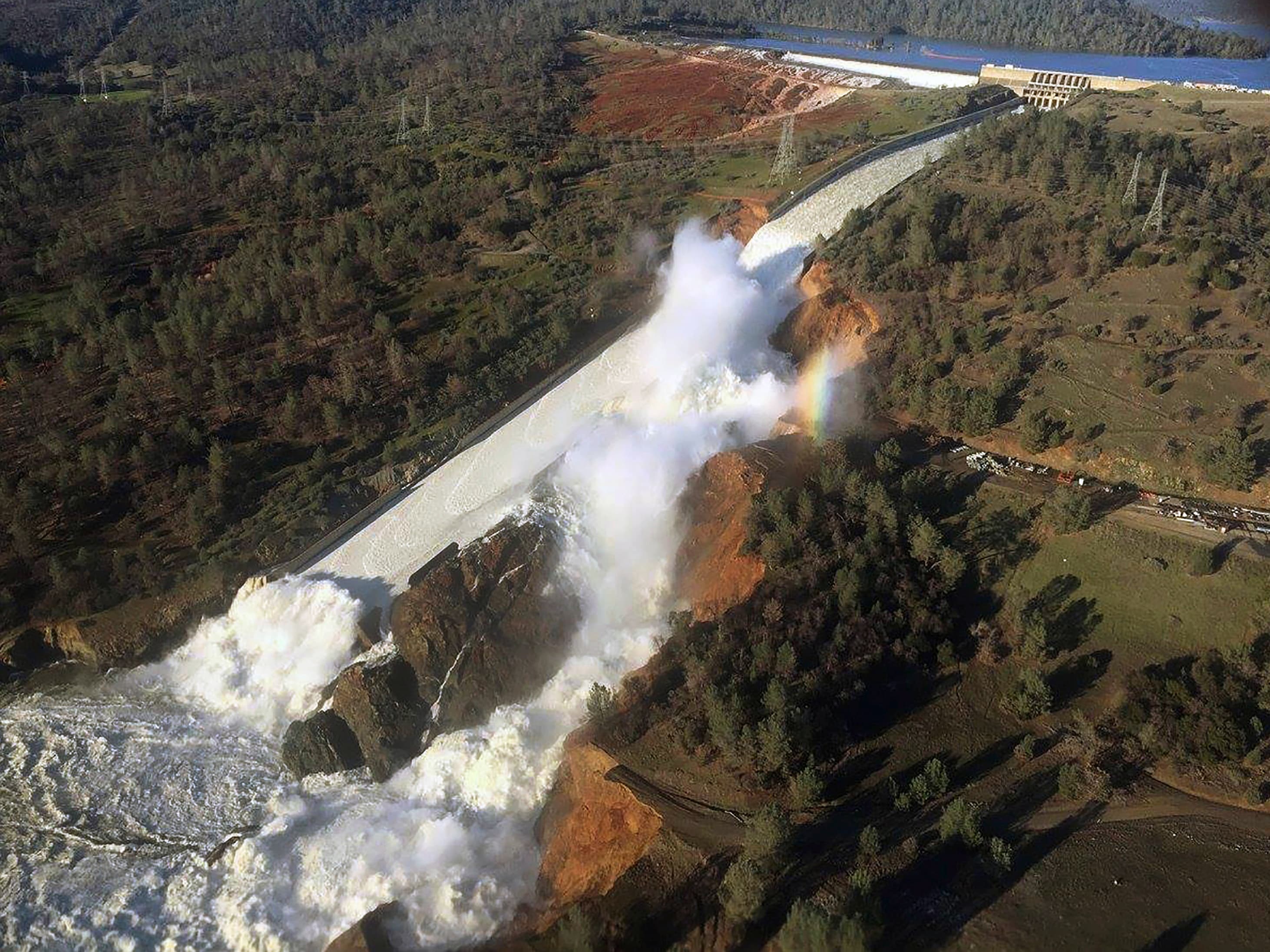
This series has, until now, been about five dams that broke. This piece is about one that did not, because the lessons of the dam that almost broke are, in many ways, more useful than the lessons of the ones that did. We do not get many opportunities to study what nearly happened.
On February 7, 2017, an operator at the Oroville Dam in California opened the main spillway at a routine flow rate and watched, on her monitor, a section of the concrete chute fail. By the next morning, a hole sixty feet wide and forty feet deep had eroded out of the spillway floor. By February 11, the lake was rising faster than the damaged spillway could safely discharge. On the morning of February 12, water flowed over the emergency spillway for the first time in the dam's fifty-year history. By the afternoon of February 12, the hillside below the emergency spillway was eroding back toward the dam at a rate that gave engineers approximately ninety minutes of remaining margin before the concrete weir at the top of the spillway could undermine and fail.
The order to evacuate one hundred and eighty-eight thousand people downstream was given that same afternoon. The weather cooperated. The reservoir level held. The crisis passed.
The Independent Forensic Team report, published in January 2018, is probably the most important document in American dam safety published in a generation. It is six hundred pages long. Every owner, every engineer, every regulator should read it. Here is what it actually says, in two minutes.
The Report Is Not About A Spillway.
The published cause of the Oroville incident is "long-term degradation of the main spillway concrete combined with a particular combination of foundation conditions that allowed uplift pressures to develop." That is the engineering finding. It is correct. It is also, in the sense that has become familiar in this series, beside the point.
The actual finding, the one in the back half of the report that does not get quoted in the trade press, is that the operator of the dam, the California Department of Water Resources, and the regulator of the dam, the Federal Energy Regulatory Commission, had collectively mischaracterized the foundation under the spillway as "good-quality rock" in every Potential Failure Mode Analysis since the dam was built. The geology reports from the 1960s had described the actual conditions accurately. The PFMAs, decade after decade, did not.
This is not a small finding. It means that for fifty years, every formal review of the most important spillway in the largest state water project in the United States had been done against an inaccurate description of the conditions it was supposed to evaluate. Not because the information was missing. Because the information was not propagating through the review system that was, on paper, looking at it.
That is the Oroville lesson, and it is a lesson about organizations, not about concrete.
The Drift That Nobody Notices.
I have a name for the failure mode the Independent Forensic Team uncovered, and I want to share it because it is, in my experience, the most common failure mode in our industry today and the one we are least equipped to see.
I call it review drift. Here is how it works.
A dam is built. A formal hazard analysis is conducted. The analysis is written into a document. Five years later, the analysis is reviewed. The reviewer does not redo the analysis; they read the previous one, check for changed conditions, and sign off. Five years after that, the same thing happens, with a different reviewer reading the previous review. Five years after that, again. And again.
Twenty years into the cycle, the original analysis is being referenced by reviewers who are referencing reviewers who are referencing reviewers, none of whom have personally inspected the assumptions in the foundational document. If an error or omission was made in the original, say, a foundation conditions characterization that is not supported by the geology reports it cites, that error has been laundered, through repetition, into received truth.
This is what happened at Oroville. The 1960s geology reports were sitting in the file. They were available. They had been available the entire time. Nobody looked at them, because the PFMA from 2005 had referenced the PFMA from 2000, which had referenced the PFMA from 1995, which had referenced, and so on, back to a document whose authors are no longer working.
Review drift is invisible from inside any single review cycle. It is only visible if someone, periodically, does the unfashionable work of going back to the primary sources and asking does the foundation document say what we have been saying it says. That work does not get budgeted. It does not get scheduled. It does not produce a deliverable that anyone wants. And so it does not get done, until the spillway fails, the IFT is convened, and someone finally pulls the original reports out of a box.
Three Questions.
For owners: on your most important dam, when was the last time someone in your organization read the original geology report, not the executive summary, the original, and compared it to what your most recent PFMA says about the foundation? If the answer is "I don't know," that is the same answer DWR would have given on February 6, 2017.
For engineers: when you cite a prior analysis in your work, do you cite it because you have read it and verified it, or because it is what your firm has always cited? Be honest with yourself. If the latter, you are a node in the review-drift pathway, and your work is propagating whatever error was introduced upstream.
For regulators: your five-year reviews are excellent at catching new problems. They are structurally weak at catching old problems that have been accepted into the baseline. What part of your process, specifically, is designed to un-accept the baseline?
The Good News.
Here is the good news, because this is DamNews. Oroville did not fail. One hundred and eighty-eight thousand people were evacuated, and one hundred and eighty-eight thousand people came home a few days later, and the dam, repaired, rebuilt, with a properly characterized foundation under the new spillway, is doing its job. That is a real outcome. The investigation that followed, and the willingness of DWR and FERC to publish a forensic report that was deeply critical of both agencies, is a real act of professional integrity that I do not want to pass over without naming.
But the lesson, the one we are still in the middle of learning, is that the review system that signed off on Oroville for fifty years is the same review system that signs off, today, on dams across the United States. The IFT did not find a problem with Oroville. They found a problem with the way we look at dams. Until that problem is fixed, and fixing it requires an organizational change, not a technical one, the next Oroville is somewhere on the map right now, waiting for its storm.
We have ninety minutes of margin, sometimes. Sometimes we do not.
You can do something this month. Pick the most important dam in your portfolio. Pull the original foundation document. Read it. Compare it, line by line, to what your current PFMA says. If the two documents are saying the same thing, you have a baseline you can trust. If they are not, you have just done, in one afternoon, a piece of work that an industry of two hundred thousand engineers does not, on average, do at all.
That is the most important hour of work in dam safety this year. It is also, this month, available to anyone reading this.